

VC Metalwork operates in a sector where fabrication demands extend far beyond basic engineering. Within the superyacht industry, every component must perform reliably under constant exposure to saltwater, vibration, UV, temperature variation, and mechanical stress, while also meeting exceptionally high aesthetic standards. Success depends not only on manufacturing capability, but on a deep understanding of how different materials behave in real marine environments.
From precision-machined components to structural fabrication and bespoke architectural metalwork, VC Metalwork supports superyacht projects through extensive experience working across a broad range of specialist marine and engineering materials.
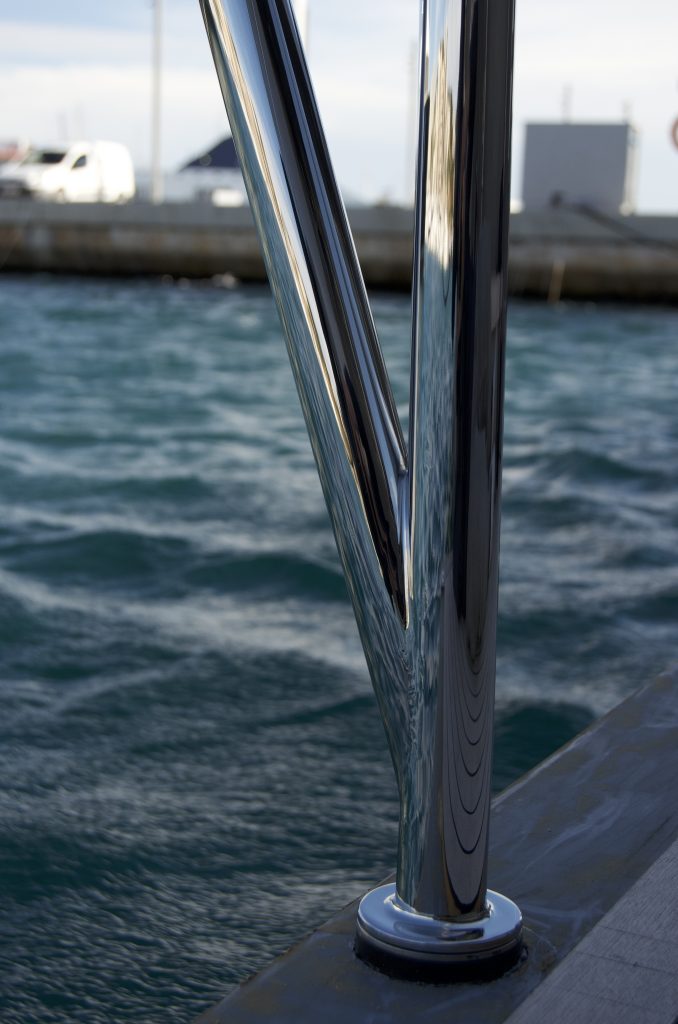
Metalwork and Marine Materials Knowledge Developed Around the Industry
Superyacht fabrication requires careful material selection for every application onboard. Structural loads, corrosion resistance, finish requirements, weight considerations, thermal movement, and classification standards all influence the choice of material long before fabrication begins.
VC Metalwork regularly works with:
- 316 Stainless Steel
- 304 Stainless Steel
- Duplex 2205
- Super Duplex 4460
- Titanium Grades 1, 2 and 5
- 5083 Aluminium
- 6082 Aluminium
- Alustar 5059
- Bronze BA20
- Bronze Ampco 45
- CuNi
- Nitronic 50
- Marine Grade Steel
- 17-4 PH Steel
- PEEK
- Delrin
- Torlon
- Vesconite
- Orkot
- Tufnol
- Tecamid
- Ertalyte
- G10 and G11 composites
- CJ Dixon
This material range allows the company to support projects spanning technical engineering, exterior deck equipment, custom fabrication, mechanical systems, structural applications, and interior architectural installations.
Understanding the Demands of Metalwork and the Marine Environment
The marine environment places unique stresses on fabricated components. Materials that perform well ashore may deteriorate rapidly at sea if they are incorrectly specified, poorly isolated, or exposed to incompatible metals.
For this reason, marine fabrication requires more than machining and welding expertise alone. It demands an understanding of corrosion behaviour, load distribution, fatigue resistance, and long-term durability.
316 stainless steel remains widely used throughout the superyacht sector for its corrosion resistance and finish quality, particularly in exposed exterior areas. In higher-load or more aggressive environments, Duplex and Super Duplex grades provide increased strength and enhanced resistance to pitting and stress corrosion.
Aluminium fabrication also requires careful alloy selection. 5083 aluminium is commonly chosen for marine structures due to its excellent weldability and seawater resistance, while 6082 may be preferred where additional structural strength is required. Alustar 5059 offers further advantages in applications where reducing weight without compromising performance is essential.
Each material brings different machining characteristics, welding requirements, and finishing considerations, all of which directly affect long-term performance onboard.
Working Beyond Traditional Metals
Modern superyacht engineering increasingly relies on advanced technical materials alongside conventional alloys.
Engineering plastics including Peek, Vesconite, Delrin, Orkot, Torlon, CJ Dixon, and Tufnol are used extensively where reduced friction, wear resistance, vibration control, electrical insulation, or dimensional stability are required.
These materials are regularly incorporated into:
- Bushings and bearing surfaces
- Rollers and sheaves
- Isolation components
- Wear pads
- Precision-machined assemblies
- Mechanical support systems
Unlike metals, these materials react differently to temperature, load, and machining processes. Correct tolerances and installation methods are critical to achieving reliable long-term operation within marine systems.
VC Metalwork’s ability to manufacture across both metallic and non-metallic materials allows projects to be approached with a complete understanding of how assemblies function as integrated systems rather than isolated parts.
Precision Manufacturing Within the Superyacht Sector
Superyacht fabrication requires a balance between engineering performance and visual refinement. Components are expected to withstand demanding operational conditions while integrating seamlessly into highly detailed yacht environments.
This applies across a wide variety of work, including:
- Bespoke stainless steel handrails
- Technical brackets and supports
- Structural fabrications
- Custom deck hardware
- Architectural metalwork
- Engine room components
- Tender equipment
- Rigging-related hardware
- Access and safety systems
- Precision-machined replacement parts
Accuracy is essential throughout the process, from material preparation and machining to welding, finishing, and final installation.

Supporting Refit and Custom Engineering Projects
No two superyacht projects are identical. Refit periods frequently involve reverse engineering obsolete parts, adapting existing systems, or manufacturing bespoke components within demanding timeframes.
In many cases, original drawings are unavailable, requiring components to be replicated directly from existing samples or redesigned to suit updated operational requirements.
Experience across a broad spectrum of materials allows VC Metalwork to support these projects with practical marine engineering knowledge alongside fabrication capability, helping ensure compatibility with existing yacht structures and onboard systems.
Engineering Capability Built Around Long-Term Performance
Within the superyacht industry, material selection influences far more than appearance. It directly affects maintenance cycles, reliability, corrosion resistance, weight management, operational safety, and overall service life.
The ability to manufacture confidently across stainless steels, aluminium alloys, titanium, bronze, composites, and advanced engineering plastics reflects a level of technical understanding developed specifically around the realities of marine operation.
That expertise remains central to delivering fabrication work capable of meeting the performance expectations of modern superyacht construction and refit projects.